How Robotics and AI Are Transforming Surgeries Worldwide
🩺 Introduction: The Rise of the Intelligent Operating Room
Imagine a world where surgeries are performed with pinpoint precision, where human error is minimized, and recovery times are dramatically shortened.
That world is no longer science fiction — it’s today’s reality, powered by Robotics and Artificial Intelligence (AI).
From robotic arms that move with sub-millimeter accuracy to AI systems that assist surgeons in real-time decision-making, AI-assisted surgery is reshaping medicine as we know it.
According to the World Health Organization (WHO), over 2 million robotic-assisted surgeries are performed annually — and the number continues to grow.
🤖 What Is Robotic Surgery?
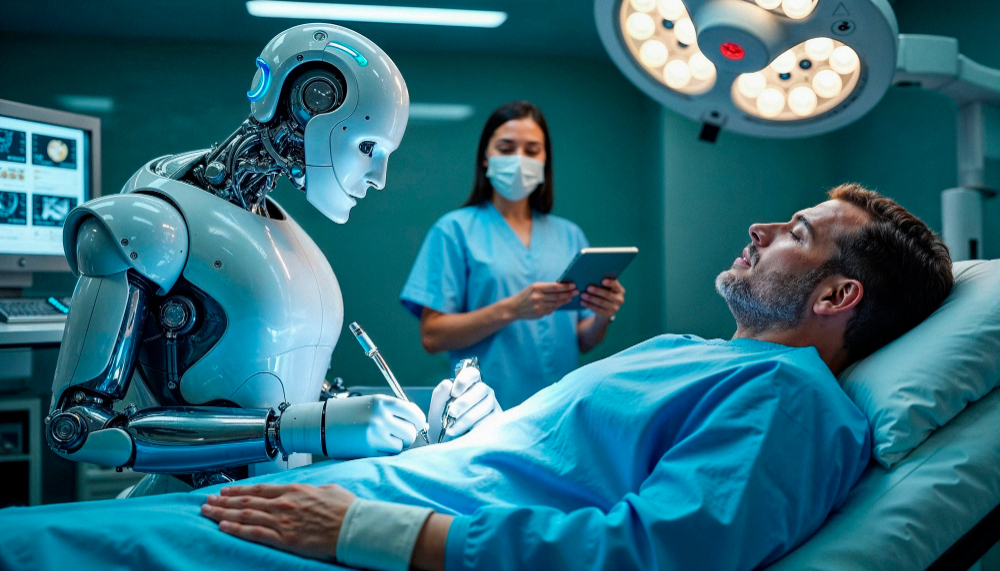
Robotic surgery involves the use of computer-assisted machines, guided by a human surgeon, to perform complex medical procedures.
While the surgeon remains in control, robotic systems provide:
Enhanced dexterity
Greater precision
3D visualization
Minimized invasiveness
Modern systems combine AI algorithms with robotics to analyze data during surgery, predict complications, and assist in real-time corrections.
🔬 How AI Enhances Surgical Robotics
1. Pre-Surgical Planning
AI analyzes CT scans, MRIs, and medical histories to create a personalized surgical map — identifying the safest incision points and best surgical pathways.
2. Real-Time Guidance
During surgery, AI systems continuously monitor the patient’s vitals and guide robotic tools to avoid nerves, vessels, and vital structures.
3. Predictive Analytics
Machine learning models predict potential complications such as excessive bleeding or infection, allowing surgeons to act before a crisis occurs.
4. Post-Surgical Recovery Optimization
AI tracks recovery data, monitors wound healing, and adjusts post-operative care plans automatically for faster recovery.
🏥 Top Robotic Surgery Systems in 2025
Robotic System
Developer
Specialty
Key Feature
Da Vinci Surgical System
Intuitive Surgical
General & urologic surgery
3D vision, precise wristed instruments
CorPath GRX
Siemens Healthineers
Cardiovascular interventions
Remote-controlled stent placement
Mako SmartRobotics
Stryker
Orthopedic (knee & hip) surgery
AI-assisted joint alignment
Hugo™ RAS System
Medtronic
Multi-specialty
Modular, cost-effective system
Versius Surgical Robot
CMR Surgical
Minimally invasive procedures
Compact, flexible robotic arms
These systems represent the new standard in robotic-assisted surgery (RAS) — combining data, robotics, and AI intelligence for superior outcomes.
🧠 AI in Surgical Decision-Making
AI doesn’t replace the surgeon — it augments their skill.
Through computer vision, AI can identify anatomical structures better than the human eye.
During procedures, it detects subtle tissue differences and provides real-time visual overlays to help guide incisions or tumor removals.
🧩 Example:
Researchers at Johns Hopkins University developed the Smart Tissue Autonomous Robot (STAR), which successfully performed intestinal anastomosis (suturing) more accurately than experienced surgeons.
This marks a major leap toward autonomous surgical assistance — not to replace humans, but to enhance their precision.
💉 Benefits of AI and Robotics in Surgery
Benefit
Impact on Healthcare
Higher Precision
Fewer surgical errors and better outcomes
Smaller Incisions
Reduced scarring and faster healing
Shorter Recovery Times
Patients go home sooner
Reduced Blood Loss
Safer and cleaner operations
Remote Surgery Possibilities
Surgeons can operate on patients thousands of miles away
Enhanced Data Collection
Better long-term patient insights
AI enables a data-driven feedback loop, improving future surgeries based on every completed procedure.
🌍 Global Impact: Making Advanced Surgery Accessible
While robotic surgery began in elite hospitals, it’s rapidly spreading worldwide:
In the U.S., over 6,000 hospitals now use robotic systems.
India and China are leading in low-cost robotic surgery solutions, making AI healthcare accessible to developing nations.
Europe focuses on regulatory frameworks ensuring robotic safety and accountability.
In Africa and Southeast Asia, mobile robotic units are being deployed for tele-surgery, connecting local clinics with global specialists.
This democratization of technology is transforming global healthcare equity.
⚖️ Challenges and Ethical Questions
Even with all its promise, robotic and AI-driven surgery faces significant challenges:
1. High Costs
Surgical robots can cost up to $2 million, limiting access to top-tier facilities.
2. Training Requirements
Surgeons need specialized training to use robotic systems effectively.
3. Data Security
AI-driven systems handle sensitive patient data — requiring strong cybersecurity measures.
4. Liability
If an AI system makes an error, who is responsible? The surgeon? The hospital? The manufacturer?
These ethical and legal questions remain hotly debated.
🚀 The Future of AI and Robotics in Surgery
By 2030, experts predict:
Autonomous surgical systems capable of performing routine tasks independently.
Remote operations powered by 5G and haptic feedback.
Augmented reality (AR) overlays for surgical visualization.
AI-driven surgical education, training surgeons in virtual reality environments.
Imagine a world where a surgeon in London can operate on a patient in Nairobi — safely, instantly, and precisely — through a robotic console.
That’s the future AI and robotics are making possible.
💬 Conclusion: The Human Touch in a Robotic World
Robots may be the hands, and AI may be the brain — but the heart of surgery still belongs to humans.
Artificial intelligence enhances precision, efficiency, and safety, but empathy, intuition, and trust remain irreplaceable.
The future of surgery is not about replacing doctors — it’s about empowering them with technology that helps save more lives, with fewer risks.
As robotics and AI continue to evolve, one thing is certain:
The scalpel is getting smarter, and the future of surgery has never looked more human.